What Micronised Creatine Means — and Whether It Matters
Micronised creatine is creatine monohydrate that has been milled to a finer particle size than standard-grade powder. That is the whole definition. The molecule itself is identical — creatine monohydrate in both cases — and the milling process does not change the chemistry, only the physical dimensions of each particle.
What the milling actually does
Standard creatine monohydrate typically has a mean particle size somewhere in the range of 200–400 microns. Micronised powder is usually milled to below 200 microns, often considerably lower. Because surface area increases as particle size falls, each gram of micronised creatine presents more surface area to the liquid you mix it with. That is why it suspends faster and settles more slowly in a glass.
The practical result is a powder that disperses with less stirring and leaves less residue at the bottom. If you have ever mixed standard creatine and found a gritty layer clinging to the glass, that is particle size at work. Micronised powder largely avoids that. There is a full guide on how to mix creatine without grit if the texture is something you find frustrating.
Does smaller particle size affect absorption?
This is where the marketing tends to get ahead of the evidence. The reasonable-sounding claim is that smaller particles dissolve better and therefore absorb faster. The problem is that creatine monohydrate does not need to be in solution to be absorbed — it is taken up across the gut wall regardless. Solubility sets a ceiling, but creatine monohydrate is already soluble enough at the doses people actually take that the ceiling is not the constraint.
No head-to-head trial has found a statistically significant difference in muscle creatine accumulation between micronised and standard-grade powder when the same total dose is consumed. The phosphocreatine system does not care how quickly the creatine dissolved in your shaker. What matters is that you hit the daily intake consistently.
The authorised claim is precise on this: creatine increases physical performance in successive bursts of short-term, high-intensity exercise, and the beneficial effect is obtained with a daily intake of 3g. The claim says nothing about particle size, because the evidence does not separate them.
So why bother with micronised at all?
Compliance. If a powder is gritty or clumps badly, some people take it less consistently or measure it less accurately. Micronised powder mixes easily into water, juice or a protein shake, which removes one friction point. That is a practical benefit, not a pharmacological one. Whether it matters to you depends on how you take it.
Some people also mix creatine into cold water with other powders, where clumping is more noticeable. Others stir it into warm drinks where standard powder would dissolve fine anyway. If you are already happy with how your creatine mixes, micronised is unlikely to change your results — only your experience of the ritual.
The Pump House powder
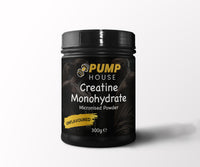
The Pump House Creatine Monohydrate Micronised Powder is 300g, providing 60 servings of 5g each. It is 100% micronised creatine monohydrate with no additives, sweeteners or fillers, manufactured in the UK to GMP standards. Single ingredient, unflavoured. It does not claim any absorption advantage over standard powder — because none is established — but it mixes cleanly, which is the reason the format exists.
If you prefer not to measure powder, the creatine tablets are the alternative. Three tablets daily reaches the 3g authorised intake. The format question is covered separately and this article does not revisit it.
What remains unsettled
Whether there is any clinically meaningful difference in absorption kinetics at the very fine end of the particle-size spectrum — below 50 microns, say — has not been tested in a way that settles the question. Some manufacturers market sub-50-micron grades specifically on bioavailability grounds. The trials are not there yet. It is possible there is a small effect; it is also possible the gut absorbs creatine at a rate that makes particle size irrelevant across any realistic range. The honest answer is that nobody knows, and the effect, if it exists, is likely small compared with the simple question of whether you take 3g every day.
For more on dosing, the guide on how much creatine per day covers the evidence on daily intake and why the 3g figure is what it is. And if you want the broader safety picture, what the evidence says on creatine safety is worth reading before you start.