Why 3g of Creatine Changes Your Phosphocreatine Stores
Three grams of creatine monohydrate is a modest-looking daily dose. Phosphocreatine (PCr) stores in muscle are discussed in millimoles per kilogram of dry muscle. These two units sound completely disconnected, and that disconnect trips up a lot of people who want to understand what the supplement is actually doing. The conversion is straightforward once you know the molecular weights involved.
The molecular weight difference
Creatine monohydrate has a molecular weight of 149.15 grams per mole. That includes the water molecule (18 g/mol) attached in the monohydrate form. Free creatine itself weighs 131.13 g/mol.
Phosphocreatine has a molecular weight of 211.11 g/mol — heavier again, because a phosphate group (about 79 g/mol) is added enzymatically inside the muscle cell by creatine kinase.
So the powder you measure in grams is creatine monohydrate. What accumulates in muscle tissue is phosphocreatine. The supplement and the stored form are chemically different compounds, which is why the numbers look so different depending on which unit you are reading.
Working through the conversion
Start with 3g of creatine monohydrate. Strip the water molecule and you have roughly 2.64g of free creatine. Divide by the molar mass of creatine (131.13 g/mol) and you get approximately 20 millimoles. That is the amount of creatine arriving in circulation from a single 3g dose.
Not all of it will be phosphorylated and retained in muscle. Absorption varies between individuals, some is excreted as creatinine before it reaches muscle, and uptake depends on the existing saturation state of the tissue. The point is that 3g of powder represents around 20 mmol of creatine — a meaningful quantity relative to total muscle PCr stores.
What the stores look like and why saturation matters
Resting PCr concentration in human skeletal muscle sits roughly between 70 and 80 mmol/kg dry muscle in unsupplemented individuals, with a theoretical ceiling around 150–160 mmol/kg dry muscle. The gap between where most people start and where stores can be fully saturated is somewhere in the region of 20–30 mmol/kg dry muscle across the major muscle groups.
That is why a single dose is the wrong frame entirely. One 3g serving does not saturate anything. What daily intake does is sustain an elevated creatine pool in plasma, which keeps muscle uptake ticking over via the creatine transporter. Over weeks, this raises the PCr available for rapid resynthesis of ATP during intense effort. The authorised claim reflects exactly this mechanism: creatine increases physical performance in successive bursts of short-term, high-intensity exercise, and the beneficial effect is obtained with a daily intake of 3g.
Saturation is the relevant concept, not acute dosing. The body reaches a new steady state; daily intake then maintains it rather than continuously adding to stores, because muscle has a ceiling.
Why there is no loading requirement
A loading phase typically means 20g per day for five to seven days, broken into four servings. The goal is to reach saturation faster — roughly a week instead of three to four weeks. The endpoint is the same. Neither Pump House creatine product recommends loading as necessary, because the research does not show that reaching saturation faster produces meaningfully different long-term outcomes for most people. You can read more about the tradeoffs on the loading phase page.
Powder or tablets — same dose, same chemistry
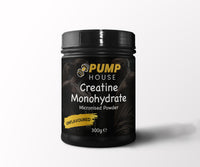
Whether you take creatine as powder or tablets, the dose and the biochemistry are identical. Pump House supplies micronised creatine monohydrate powder with a 5g scoop — 60 servings per 300g tub — or 1,000mg creatine tablets at three per day to reach the 3g threshold. If you are deciding between them, the powder vs tablets guide covers the practical differences.
What remains unsettled
The conversion above assumes complete absorption and full phosphorylation, neither of which is guaranteed. Individual variation in the creatine transporter means some people respond strongly to supplementation and a minority — so-called non-responders — show little change in muscle PCr regardless of intake. Estimates of non-response vary across studies and there is no simple test to know in advance which group you fall into. The honest answer is that the mechanism is well understood, but individual outcomes are not perfectly predictable from the dose alone.