Why unflavoured creatine still has a taste
Unflavoured creatine does have a taste. It is mild, slightly bitter, occasionally chalky, and it does not go away no matter how thoroughly you mix it. That is not a defect. It is what pure creatine monohydrate actually tastes like, and understanding why saves a lot of unnecessary worry.
What 'unflavoured' means on the label
'Unflavoured' is a declaration about ingredients, not a promise of sensory neutrality. It means no flavouring agents, sweeteners, flavour enhancers or masking compounds have been added. Water is unflavoured. It still tastes like water. The same logic applies here.
Flavoured creatine products typically layer in sweeteners such as sucralose or acesulfame potassium, alongside fruit or citrus compounds, specifically to cover the base taste of the creatine itself. When you choose unflavoured, you are opting out of all that — which is a reasonable thing to do — but you are not opting into a product with no organoleptic properties at all.
Where the taste comes from
Creatine monohydrate is a small organic molecule: a nitrogenous compound found naturally in muscle tissue. Its chemical structure gives it a weakly polar character that interacts with taste receptors, particularly those associated with bitterness. This is not contamination. It is not a sign of low purity. It is the molecule.
The intensity varies between people. Taste sensitivity to bitter compounds differs genetically — some people barely register it, others find it more pronounced. Temperature matters too. Cold water tends to blunt it; warm water can bring it forward slightly. The same dose, the same batch, can taste noticeably different depending on what you mix it with and how cold your drink is.
Micronisation — the process of grinding the particles to a finer size — affects mixability and mouthfeel rather than flavour directly. Finer particles disperse more evenly, which can reduce the gritty or chalky texture that sometimes accompanies coarser grades, but it does not remove the inherent taste of the molecule itself. If you want more on what micronisation actually changes, see how micronised and standard creatine monohydrate compare.
Is a stronger or unusual taste a warning sign?
A mild bitter or chalky note is normal. What would be unusual is a sharp acidic taste, a pronounced sourness, or anything that changes noticeably between batches of an otherwise consistent product. Those could point to degradation or contamination and would be worth querying with the supplier.
Creatine monohydrate is chemically stable in dry form. In solution it begins to convert slowly to creatinine, particularly in warm or acidic conditions, but this happens over hours, not minutes, and at normal serving concentrations the effect is negligible. If you mix your creatine and drink it within a few minutes, which is the sensible approach, conversion is not a practical concern.
What you can do about the taste
The simplest fix is to mix it with something that has a flavour of its own. Juice works well. So does a flavoured squash, provided it is diluted enough that you are actually drinking a reasonable volume of fluid. Milk — dairy or plant-based — rounds out the bitter edge. Cold water with the temperature low enough genuinely does help.
Volume matters. A 5g serving dissolved in 150ml of water gives a more concentrated, more noticeable taste than the same dose in 400ml. Dilute it further and the taste recedes accordingly. There is no absorption benefit to a smaller volume; spread it out.
Some people mix creatine into porridge, yoghurt or a smoothie and register no taste at all against a stronger flavour background. If the powder format is not working for you, creatine monohydrate tablets bypass the taste question entirely — you swallow them whole, and the 3g daily intake from three tablets matches the intake specified in the authorised performance claim.
Why some products taste different from others
Purity and particle size are the two main variables between unflavoured creatine products. A higher-purity monohydrate has less of the non-creatine fraction that can contribute off-notes. Micronised grades disperse better and feel less gritty. Neither of these erases the taste, but both affect the overall sensory experience.
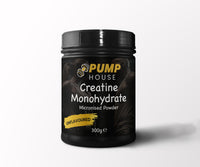
Pump House Creatine Monohydrate Micronised Powder is 100% micronised creatine monohydrate with no additives, sweeteners or fillers — nothing added, nothing masked. The 300g tub gives 60 servings of 5g each. The taste you notice is the creatine. That is the point.
If you are deciding between powder and tablets on practical grounds beyond taste, the powder vs tablets guide covers the differences worth thinking about.